Huang Tsuo
The Killing RoomHuang Tsuo is the chief of Section Two, responsible for serious crimes including murder and robbery, and Nien Mei-Ling’s superior. He enters the investigation as a senior officer whose authority is soon contested by Li Yan, but his conduct is not reducible to office politics: his wife’s grave illness shadows his work, and a quiet moment of support from Nien Mei-Ling reveals how much of his private distress has been mistaken for distance. His role joins the novel’s institutional conflict to a personal crisis that colleagues can only partly see.
Identity and Introduction
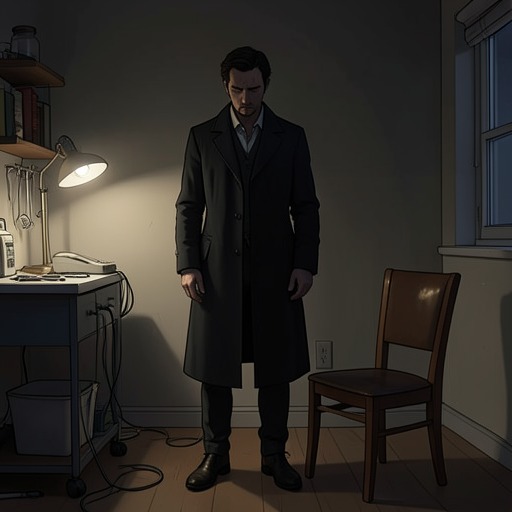
When Li Yan first visits Section Two, he finds a crowded detectives’ room alive with telephones, conversation, keyboards, and computer terminals. Huang’s office, by contrast, is dark except for the circle of light cast by a desk lamp. Huang stands beside the desk on the telephone, his face in shadow; the reflected light makes his expression difficult to read. He is of medium height and stocky, around forty-five, with thick hair swept back from a square face. Though described as good-looking, he appears drawn and tired, with nervous, watery eyes.
The call is about Huang’s wife. Nien Mei-Ling asks softly how she is, and Huang answers that her condition is not good. The exchange establishes that his distraction has a serious private cause before Li has much opportunity to know him. Nien Mei-Ling introduces Huang as her boss and the chief of Section Two, explaining that the unit handles serious crime. Huang’s handshake with Li is cold and cursory; he barely meets the visiting deputy chief’s eyes. He then tells Nien Mei-Ling to arrange a full briefing for when he and Li return, presenting himself at once as a supervisor who expects his department to remain under his direction.
A Private Crisis at the Edge of the Case
Huang’s wife’s illness repeatedly interrupts the public business of the investigation. At a banquet attended by Margaret Campbell, Huang picks at his food and takes little part in the conversation. Margaret notices his careworn appearance and does not recall seeing him smile. When a waitress brings him a message from the hospital, he pales, rises immediately, and speaks rapidly to Director Hu before hurrying out. The Commissioner tells Margaret that Huang’s wife is very unwell. The brief departure makes visible what his earlier distracted manner had concealed: his attention is divided by news he cannot treat as routine.
Later, after a detectives’ briefing, Li Yan sees Nien Mei-Ling standing beside Huang in his office. She touches his hand and rests her other hand on his arm. Li reads the gesture as intimacy and feels jealous, not knowing that Margaret Campbell had experienced a similar jealousy when Nien Mei-Ling touched Li. Nien Mei-Ling soon explains the context: the hospital is sending Huang’s wife home, and she believes the doctors expect her to die there. Li’s initial relief at learning the gesture was sympathy gives way to guilt. The scene does not make Huang’s grief public through a speech; it reaches Li indirectly, through an act of care and the news that follows it.
Authority and Conflict with Li Yan
Huang’s position becomes more precarious when Director Hu appoints Li Yan to lead the investigation over his head. After Hu’s motorcade leaves them in the rain, Huang tells Li that Li reports to him, not to the director. The assertion sets the terms of their working relationship: Li has responsibility for the case, but Huang still claims authority over the local department and its detectives.
Their dispute becomes explicit when Huang confronts Li in his office. He objects that Li has taken members of the pathology department from their beds during the night and called the detective shift in two hours early without consulting him. Li replies that he was placed in charge of the investigation and challenges Huang to dismiss him. The disagreement is not merely procedural. Li believes Huang is using departmental authority to undermine a leadership appointment made by Director Hu; Huang sees Li’s actions as bypassing the Section Chief and his control of the staff.
Nien Mei-Ling enters during the confrontation and is surprised that Li did not call her. Li says he needed foot soldiers, not generals. Huang then points out that the inquiry has turned toward Cui Feng, a personal friend of Director Hu. His objection exposes the political sensitivity of the case: the investigation is no longer simply a question of how to deploy officers, but of whether it can scrutinize an influential figure.
Cui Feng and the Limits of the Investigation
Li explains that relatives of four of the five identified victims have said the women obtained abortions at clinics belonging to Cui Feng. He wants access to the clinic records so the detectives can compare them with missing-person files and potentially identify more of the dead women. Huang answers that Cui’s organization performs most of the abortions in Shanghai, so the connection alone is not unusual. Li agrees that the fact does not itself imply wrongdoing; he wants the records as an investigative resource, not as proof of a crime.
Huang nevertheless insists that Cui is a Party member and an influential figure in the community, and that the department must not impugn his reputation. Nien Mei-Ling argues that they can at least ask to see the records. Huang initially directs his anger at Li, then holds Li’s gaze before turning to her. His eventual agreement is limited: she may ask Cui for access. The exchange shows both the force and the boundary of Huang’s resistance. He will not accept an inquiry that appears to accuse Cui without evidence, yet he does not finally forbid the request that could help identify the victims.
Character and Narrative Role
Huang is presented through contrasts rather than a settled portrait. He is a department chief who expects obedience, but also a man repeatedly pulled away by a wife’s deteriorating condition. His cold manner at his first meeting with Li and his later visible distress do not cancel each other; together they make his reserve legible as more than a simple measure of temperament. The narrative also lets readers encounter him through other people’s partial interpretations: Margaret sees a dour, careworn guest, Li mistakes Nien Mei-Ling’s sympathy for romantic closeness, and the detectives see a chief locked in conflict with the officer leading their case.
His clashes with Li place the investigation inside a chain of competing authority, from the Section Chief to the deputy appointed by Director Hu and the influential people whose reputations the police may disturb. Huang’s insistence on protecting Cui’s standing may impede Li’s effort to pursue useful records, but the evidence does not establish that Huang knows of any criminal connection. His significance lies in that unresolved pressure: personal vulnerability and institutional responsibility coexist with a defensive response to scrutiny, while the case requires the department to distinguish a politically sensitive lead from an accusation.